
Content Marketing Strategies for Social Sellers: How to Get Inbound Enquiries
A step-by-step content strategy to attract buyers and team members who message you first — no outreach required.

If you have ever felt like the only way to grow in social selling is to message more people, follow strangers, or start awkward conversations with people who have not asked for your help, I want you to know there is another way.
Strong content marketing strategies help social sellers attract buyers, build trust, create conversations, and generate inbound enquiries without relying on cold DMs.
This is not about hoping people appear in your inbox. It is about creating content with a clear purpose.
There are four content types every social seller should rotate consistently:
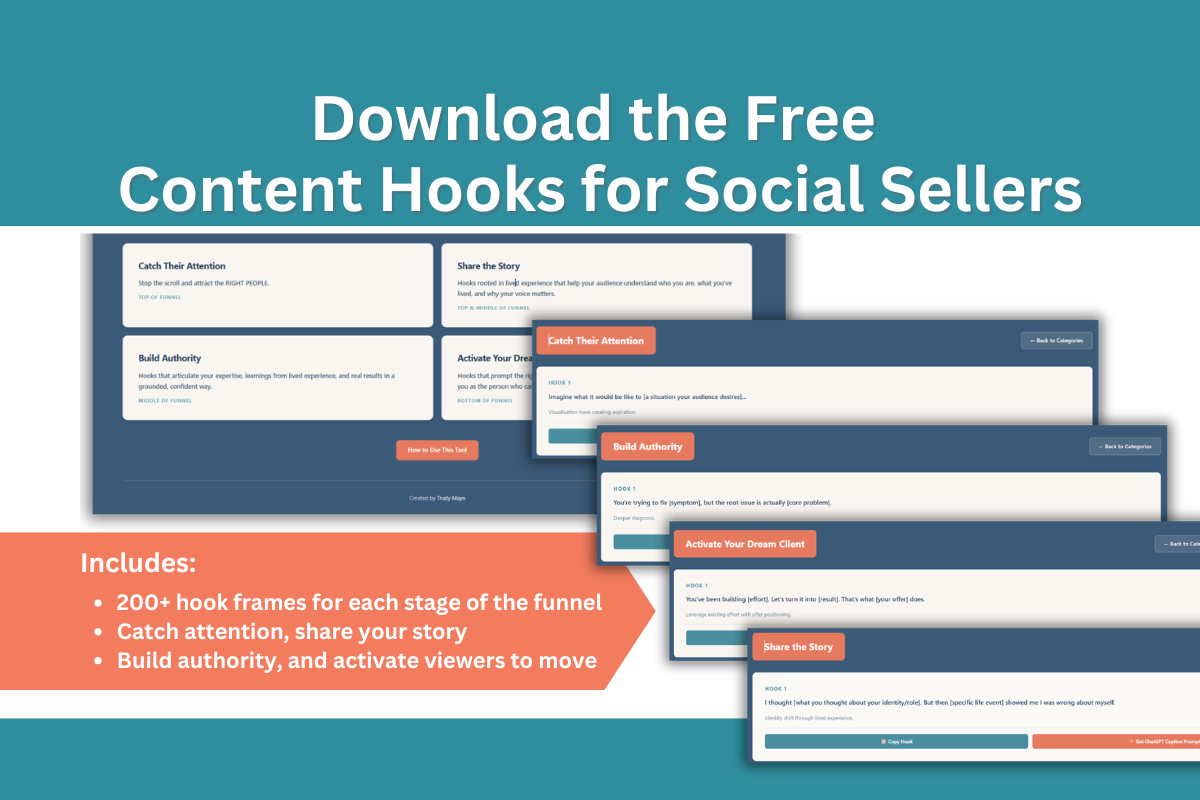
Catch Their Attention
Share the Story
Build Authority
Activate Your Dream Client
Get the free Content Hooks for Social Sellers: A free tool that give content ideas that attract the right people, build trust, and have the right audience reaching out to you
Catch Their Attention
Catch Their Attention is top-of-funnel content. It is problem-aware content that stops the scroll and names what your audience is already experiencing.
This is not about pitching your product or opportunity. It is about helping someone think, “That’s me.”
Why this matters
One of the most effective content marketing strategies for social sellers is learning how to create relevance before making an offer.
If your posts always begin with the product, the business, or the opportunity, you are asking people to care too early. But when you start with a problem they already recognise, the right people stop scrolling and pay attention.
This is how social sellers begin attracting leads without constantly messaging strangers.
Team-building example
“If you are earning decent money but still feel like you have no breathing room, this is for you.”
From there, talk about being busy all week but still feeling stretched.
Product-selling example
“If your skin feels dull no matter how many products you try, the problem might not be that you need more steps.”
From there, talk about product overload and why a simpler routine can work better.
Share the Story
Share the Story is top and middle-of-funnel content. It is personal content rooted in lived experience. This is where people begin to understand who you are, what you stand for, and why your voice matters.
A lot of social sellers skip this because they think their audience only wants tips or offers. But people do not just buy the product. They buy from the person they trust.
Why storytelling matters
Connection is one of the most overlooked content marketing strategies in social selling.
People want to know the person behind the content. They want to understand your values, your experiences, and why you care about what you do.
This does not mean oversharing. It simply means allowing your audience to see the lessons, moments, and experiences that shaped your perspective.
Team-building example
Share the moment you realised you did not want to build a business that required you to live on your phone. Talk about being a mum, wanting flexibility, and refusing to create another job that left you drained.
Product-selling example
Share the moment you realised your own routine was not working. Maybe you had a cupboard full of products but still felt frustrated. Then explain what changed when you stopped chasing quick fixes.
Build Authority
Build Authority is middle-of-funnel content. This is where you teach, demonstrate, explain, and show proof.
It is not about trying to look impressive. It is about helping people feel confident that you know what you are talking about.
Why authority content works
The best content marketing strategies do not just create connection. They create confidence.
People may relate to your story, but they still need to trust your recommendations. Authority content bridges that gap by helping your audience feel informed, supported, and clear on how you can help them.
Team-building example
“Three things I would focus on if I were starting my social selling business again.”
You could talk about choosing a clear audience, creating content that starts conversations, and learning to invite without sounding desperate.
Product-selling example
A simple tutorial showing how to layer skincare products, build a morning wellness routine, or choose the right product based on a specific concern.
A note on proof
You do not need huge claims, dramatic transformations, or old momentum stories.
Share the small, real things:
A customer who feels more confident
A team member who posted consistently
A lesson from your own growth
Real proof feels better than hype.
Activate Your Dream Client
Activate Your Dream Client is bottom-of-funnel content. This is where you invite the right people to take the next step.
A lot of social sellers are good at posting helpful content, but they forget to invite. Then they wonder why nobody is asking about the product or business.
Why activation matters
One of the biggest mistakes social sellers make with their content marketing strategies is assuming people know how to work with them.
Your audience cannot always read between the lines. Sometimes they need a clear, simple invitation.
Activate content turns interest into action.
Team-building example
“If you have been quietly wondering whether you could build something alongside motherhood, work, or everyday life, I have space to mentor a few new people this month.”
Then explain who it is for and what support looks like.
Product-selling example
“If your current routine is not giving you the result you want, I can help you simplify it.”
Then invite people to message you with a keyword, answer a question, or book a quick chat.
Make Your Profile Match Your Strategy
Once your content starts working, people will click through to your profile. When they do, your profile needs to answer three questions quickly:
Who do you help?
How do you help them?
What should they do next?
Your bio should be clear, not clever.
If you sell products, make it obvious what problem you help people solve. If you are building a team, make it clear what kind of person you support and what your approach looks like.
Instead of:
“Building my dream life”
You might say:
“Helping busy women simplify social selling with content that attracts buyers and team members.”
Instead of:
“Wellness lover”
You might say:
“Helping women simplify their wellness routine and feel more like themselves again.”
Pin content that supports your strategy:
One post that catches attention
One that shares your story
One that builds authority
One that clearly invites people to work with you
Final Thoughts
The best content marketing strategies for social sellers are not built around pressure, scripts, or constant outreach.
They are built around relevance, trust, clarity, and connection.
Catch Their Attention so they feel seen
Share the Story so they trust you
Build Authority so they believe you can help
Activate Your Dream Client so they know what to do next
That is the whole framework.
When social sellers rotate these four content types consistently, content stops feeling random and starts creating inbound conversations naturally.
Your content becomes the thing that starts the conversation for you.
About Trudy
Mum, social seller, and content strategist. I teach social sellers how to get inbound enquiries through content that actually connects — no scripts, no DM spam, no posting 5 times a day.
Get free Content Hooks for Social Sellers

Connect with me: